
Steps to Calories Calculator
Calculate calories burned from your steps, height, weight, and walking pace.
Results
Calories burned
Calories per step
0.03753 kcal
Distance
7.02 km (4.4 mi)
That's about 1.5 slices of pizza worth of calories burned.
How Steps to Calories Calculator Works
Steps to Calories Formula
This calculator uses Metabolic Equivalent of Task (MET) values to estimate calories burned. The formula is:
Calories = MET × 3.5 × body weight (kg) / 200 × duration (minutes)
A MET value of 1.0 equals the energy cost of sitting still. Walking at moderate pace carries a MET value of 3.49 — you burn 3.49 times more energy than at rest. The MET formula was developed from exercise physiology research and is used by the American College of Sports Medicine (ACSM) for activity-based calorie estimation.
How Weight Affects Calories Burned
A heavier body requires more energy to move. A person weighing 90 kg (198 lbs) burns approximately 28% more calories per step than a person weighing 70 kg (154 lbs) at the same pace and distance. The relationship is linear — double the weight, roughly double the calories for the same walk.
How Height and Stride Length Affect Your Steps
Taller people take longer strides and cover more distance per step. This calculator estimates stride length as a percentage of height:
- Male stride length: height × 0.415
- Female stride length: height × 0.413
A person 180 cm (5'11") tall covers roughly 5% more distance per step than someone 170 cm (5'7") tall. More distance per step means more work per step and more calories burned per step.

How Walking Pace Changes the Result
Brisk walking burns 80% more calories than slow walking for the same step count.
| Pace | Speed | MET Value | Cal / 10k Steps* |
|---|---|---|---|
| Slow | 3.2 km/h (2 mph) | 2.77 | ~280 kcal |
| Moderate | 4.8 km/h (3 mph) | 3.49 | ~375 kcal |
| Brisk | 6.4 km/h (4 mph) | 4.98 | ~505 kcal |
*Based on 70 kg (154 lb), 170 cm (5'7"), male
Your Results Explained
After calculating, you see 4 key metrics:
- Total calories burned — the estimated energy spent during your walk, displayed in kilocalories (kcal).
- Calories per step — total calories divided by your step count. Most adults fall between 0.02 and 0.06 kcal per step.
- Distance covered — estimated from your height-based stride length, shown in both kilometers (km) and miles (mi).
- Duration — estimated walking time based on your selected pace.
Your exact calorie burn depends on terrain, walking form, and individual metabolism. Use these numbers as a reliable baseline, not a medical measurement.
Steps to Calories Chart
The table below shows estimated calories burned at each step count for a 70 kg (154 lb) person, 170 cm (5'7") tall, walking at moderate pace (4.8 km/h / 3 mph).
| Steps | Calories Burned | Distance | Duration |
|---|---|---|---|
| 5,000 | ~188 kcal | 3.5 km (2.2 mi) | 44 min |
| 6,000 | ~225 kcal | 4.2 km (2.6 mi) | 53 min |
| 8,000 | ~300 kcal | 5.6 km (3.5 mi) | 70 min |
| 10,000 | ~375 kcal | 7.0 km (4.4 mi) | 88 min |
| 12,000 | ~450 kcal | 8.4 km (5.2 mi) | 105 min |
| 15,000 | ~563 kcal | 10.5 km (6.5 mi) | 132 min |
| 20,000 | ~751 kcal | 14.0 km (8.7 mi) | 176 min |
Your exact number will vary based on weight, height, sex, and pace. Use the calculator above for a personalized estimate.
How Many Calories Does 10,000 Steps Burn?
10,000 steps burns approximately 350–450 calories for most adults, depending on body weight, height, sex, and walking pace.
Here is a worked example:
Example: 75 kg (165 lb) male, 175 cm (5'9"), moderate pace
- Stride length: 175 cm × 0.415 = 72.6 cm (0.000726 km per step)
- Distance: 10,000 × 0.000726 = 7.26 km (4.5 mi)
- Duration: 7.26 km ÷ 4.8 km/h × 60 = 90.8 minutes
- Calories: 3.49 × 3.5 × 75 ÷ 200 × 90.8 = 416 kcal
The same 10,000 steps for a 60 kg (132 lb) female at slow pace (3.2 km/h) burns approximately 241 kcal — a 42% difference. Body weight and pace are the two largest factors in the calculation.


Calories Burned by Step Count and Calorie Goal
Calories Burned by Step Count
Common daily step counts and their approximate calorie burn for a 70 kg (154 lb) person at moderate pace:
- 3,000 steps: ~113 kcal — typical sedentary day
- 5,000 steps: ~188 kcal — lightly active
- 7,500 steps: ~281 kcal — moderately active
- 10,000 steps: ~375 kcal — active (recommended daily target by the World Health Organization)
- 15,000 steps: ~563 kcal — very active
- 20,000 steps: ~751 kcal — high-volume training day
Steps Needed to Burn a Calorie Goal
Working backward from a calorie target (70 kg person, moderate pace):
- 100 calories: ~2,660 steps
- 200 calories: ~5,320 steps
- 300 calories: ~7,980 steps
- 500 calories: ~13,300 steps
- 1,000 calories: ~26,600 steps
These numbers scale proportionally with weight. A lighter person needs more steps to reach the same calorie goal; a heavier person needs fewer.
Steps, Calorie Deficit, and Weight Loss
1 pound (0.45 kg) of body fat stores approximately 3,500 calories. To lose 1 pound per week through walking alone, you need a daily calorie deficit of 500 kcal — about 13,300 steps at moderate pace for a 70 kg (154 lb) person.
Weight loss through walking works best when combined with dietary control. Walking burns calories, but eating above your total daily energy expenditure (TDEE) cancels out the deficit.
3 facts about steps and weight loss:
- Consistency beats intensity. Walking 8,000 steps daily for a year burns more total calories than sporadic 20,000-step days.
- The calorie deficit must be sustainable. A 250 kcal daily deficit (~6,650 extra steps) leads to about 0.5 lb (0.23 kg) of fat loss per week.
- Your body adapts. After several weeks of the same routine, your body becomes more efficient. Increase pace or steps periodically to maintain the same burn rate.


Tips to Burn More Calories While Walking
Walk Faster
Increasing pace from slow (3.2 km/h / 2 mph) to brisk (6.4 km/h / 4 mph) nearly doubles your calorie burn per minute. Brisk walking (MET 4.98) burns 80% more calories than slow walking (MET 2.77) for the same distance. Aim for a pace where you can talk but not sing.
Add an Incline
Walking uphill increases MET value by 30–50% compared to flat ground. A 5% incline at moderate pace raises the MET from 3.49 to approximately 5.0. Use hills, parking ramps, or a treadmill incline to increase burn without adding steps.
Take the Stairs
Stair climbing has a MET value of 8.0–9.0, roughly 2.5 times the intensity of flat walking. Replacing 1 elevator trip per day with 3 flights of stairs (about 36 steps) burns an extra 15–20 kcal. Over a year, that adds up to approximately 5,500 extra calories — about 1.5 lbs (0.7 kg) of fat.
Increase Daily Step Count Gradually
Add 500–1,000 steps per week to your baseline. Jumping from 4,000 to 10,000 steps overnight increases injury risk and is hard to sustain. A gradual ramp-up over 6–8 weeks builds the habit and lets joints adapt.
Health Benefits of Walking
The World Health Organization (WHO) recommends 150–300 minutes of moderate-intensity physical activity per week for adults, including brisk walking.
Regular walking at 7,000+ steps per day reduces the risk of cardiovascular disease by 50–70%, according to research published in JAMA Internal Medicine. Walking lowers blood pressure, improves blood sugar regulation, strengthens bones, and reduces symptoms of anxiety and depression.
The American Heart Association (AHA) identifies walking as the simplest form of cardiovascular exercise. Walking requires no equipment, no gym membership, and no special training.

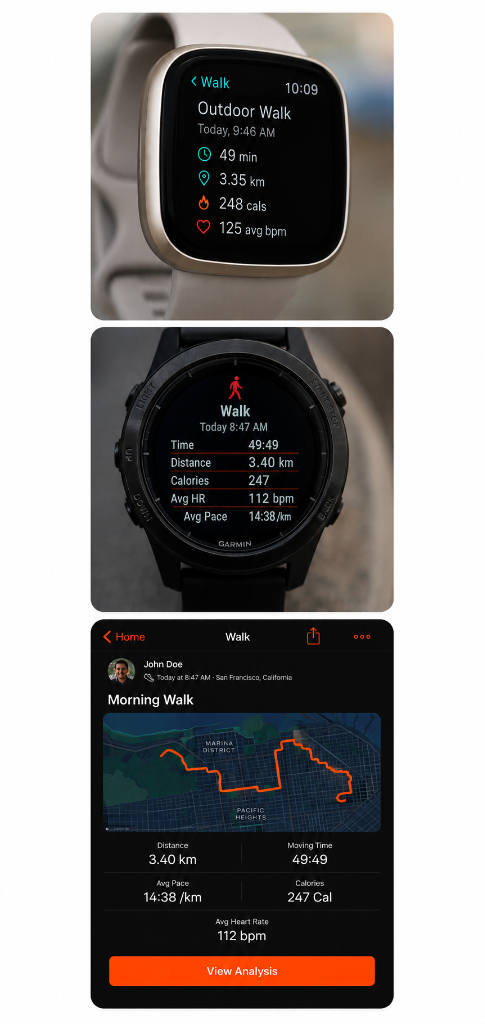
How Fitbit, Garmin, and Strava Calculate Calories from Steps
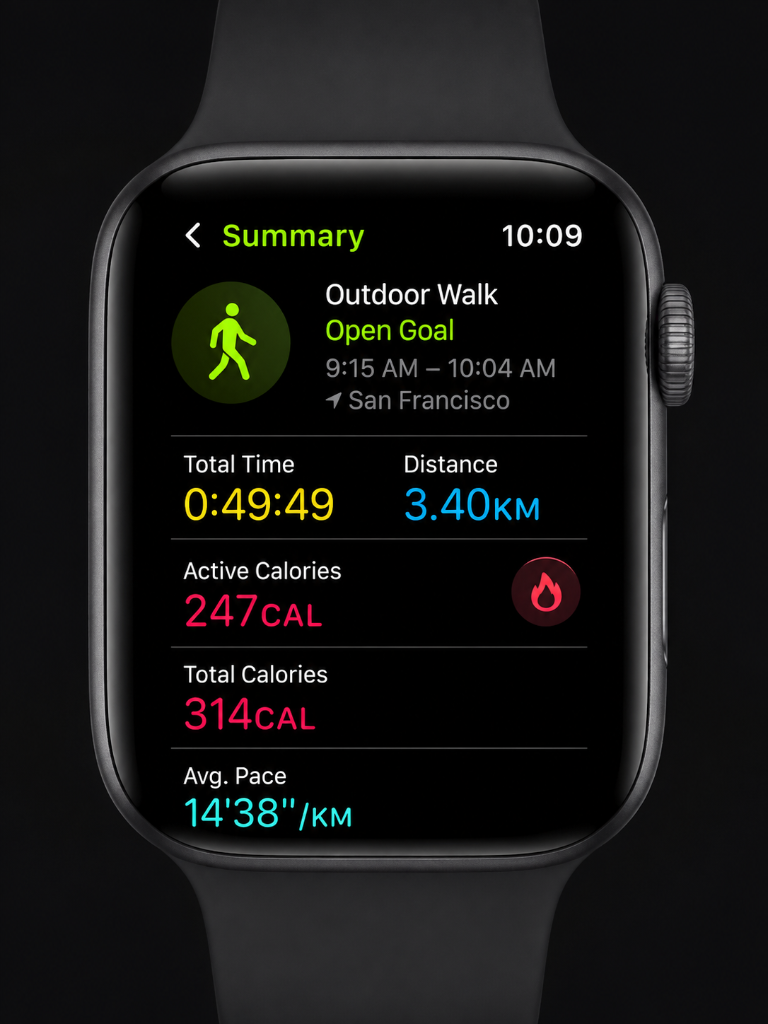
Fitness trackers and apps use different methods to estimate calories from steps. The numbers on your wrist rarely match this calculator — or each other.
Fitbit
Uses a proprietary algorithm that combines step data with heart rate (on models with HR sensors), basal metabolic rate (BMR), and activity intensity. Fitbit's calorie count includes both resting and active calories, so the total is always higher than a steps-only calculation.
Garmin
Uses the Firstbeat Analytics engine, which factors in heart rate variability, VO2max estimates, and respiration rate on supported devices like the Garmin Forerunner. Garmin separates "active calories" from "resting calories" in its app. The active calorie figure is closest to what this calculator shows.
Strava
Estimates calories from GPS-based distance and pace, not step count. Strava does not use MET values — Strava relies on a simpler speed-based model that can differ by 10–20% from MET-based calculations.
Apple Watch & Samsung Health
Use similar hybrid approaches — combining accelerometer data, heart rate, and user profile (age, sex, weight, height) to estimate calories. These estimates tend to run 5–15% higher than MET-only calculations because Apple Watch and Samsung Health account for excess post-exercise oxygen consumption (EPOC).
The main takeaway: device-reported calories include resting metabolic burn; this calculator shows only the calories from the walk itself. Both numbers are estimates. Use one method consistently to track trends over time.
Explore More Fitness Calculators
Explore our specialized energy, walking, running, and weight-loss deficit calculators tailored for your daily activity goals.
Calories Burned Calculator
Calculate energy burned across diverse physical activities, calisthenics, and exercises.
Walking Calorie Calculator
Estimate walking energy expenditure based on exact distance, duration, and pace speeds.
Weight Loss Calculator
Plan your daily step targets and calorie deficit timeline to reach your goal body weight.
Running Calorie Calculator
Track energy expenditure for light jogging, tempo road running, and sprint intervals.
Frequently Asked Questions
Common questions about the steps to calories calculator, walking, and calorie burn.
How many calories does 10,000 steps burn?
10,000 steps burns approximately 350–450 calories for most adults. The exact number depends on body weight, height, sex, and walking pace. A 70 kg (154 lb) person walking at moderate pace (4.8 km/h / 3 mph) burns about 375 kcal.
How many steps do I need to burn 100 calories?
Approximately 2,500–3,000 steps burn 100 calories for an average-weight adult at moderate pace. A heavier person reaches 100 kcal in fewer steps; a lighter person needs more.
How many steps do I need to burn 500 calories?
Approximately 13,000–14,000 steps burn 500 calories for a 70 kg (154 lb) person walking at moderate pace. Brisk walking reduces the step count needed to approximately 10,000 steps.
How is calories burned from steps calculated?
This calculator uses the Metabolic Equivalent of Task (MET) formula: Calories = MET × 3.5 × body weight (kg) / 200 × duration (minutes). Stride length (estimated from height and sex) converts step count into distance, and walking pace determines the MET value.
How does height affect stride length and calories burned?
Taller people have longer strides and cover more distance per step. A person 185 cm (6'1") tall covers about 8% more distance per step than someone 165 cm (5'5") tall. More distance per step means more work per step and more calories burned.
Does sex affect the calorie calculation?
Yes, sex affects calorie burn by approximately 5–10%. Men have slightly longer average stride lengths and higher resting metabolic rates due to greater average muscle mass. This calculator applies a sex-based stride length adjustment and a metabolic modifier.
Does walking in place burn calories?
Yes, walking in place burns calories, but approximately 20–30% fewer than walking forward. Walking in place eliminates the forward propulsion component, which reduces energy expenditure. Expect roughly 150–250 kcal per 10,000 in-place steps, compared to 350–450 kcal for regular walking.
Does walking side to side burn calories?
Yes, lateral walking burns calories at a rate comparable to forward walking. Side-to-side movement activates the hip abductors and adductors more than forward walking, which can slightly increase energy expenditure — roughly 5–10% more than the same pace walking forward.
Do I burn more calories walking in heels?
Yes, walking in heels burns slightly more calories per step — roughly 5–10% more than flat shoes. Heels shift your center of gravity forward, forcing calves and core to work harder. Heels also shorten stride length, so you need more steps to cover the same distance.
Does 10,000 steps a day help with weight loss?
Yes, 10,000 daily steps can support weight loss when combined with a calorie deficit. At moderate pace, 10,000 steps burns approximately 350–450 kcal. Over a week, that is 2,450–3,150 kcal — close to 1 pound (0.45 kg) of fat loss, assuming no increase in food intake.
What exactly is a calorie?
A calorie (cal) is a unit of energy. One kilocalorie (kcal), commonly called a "Calorie" with a capital C, equals the energy needed to raise 1 kilogram (2.2 lbs) of water by 1 degree Celsius (1.8°F). Food labels, fitness trackers, and this calculator all use kilocalories when displaying "calories."